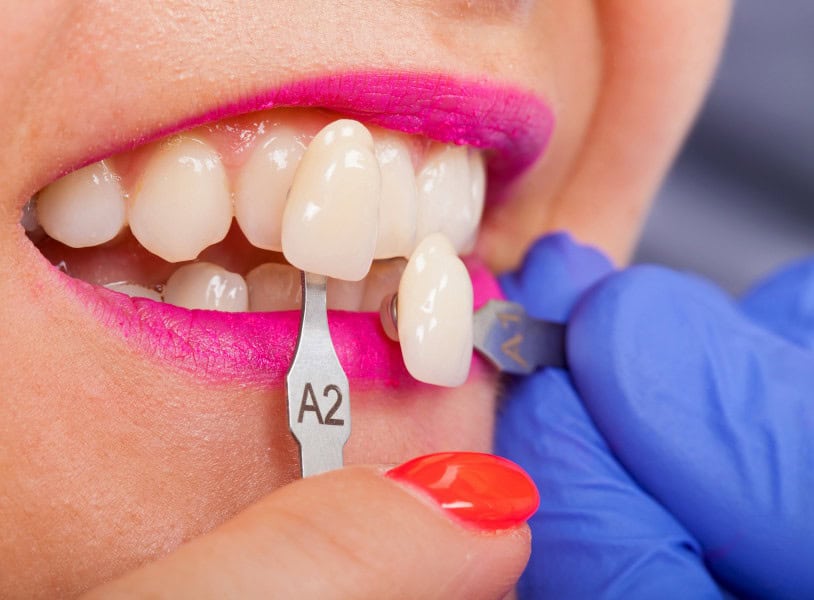
One of the most common hesitations I see in patients isn’t about physical pain—it is the emotional weight of hiding their smile.
You might know the feeling well. You laugh at a joke, but your hand instinctively flies up to cover your mouth. You look at photos and wish your teeth looked longer, or that your gums didn’t take center stage. If you have been researching how to fix a “gummy smile,” you have likely encountered two very different solutions: periodontal surgery and cosmetic restoration. Specifically, you are likely weighing the options of crown lengthening vs veneers.
As a periodontist, I view the mouth through a lens that combines biology with architecture. I don’t just look at the white part of the tooth; I look at the foundation that holds it. I often been asked by patients in my Beverly Hills office, “Dr. Moshrefi, can’t I just put veneers on my teeth to make them look bigger?” The answer is rarely a simple yes or no. It requires understanding why your smile looks the way it does and ensuring that whatever solution we choose promotes long-term health, not just a temporary aesthetic fix.
In this guide, I want to walk you through the nuances of these procedures. We are going to move past the surface-level marketing you see on social media and dive into the medical and structural realities of transforming a smile. My goal is to help you feel educated, empowered, and less anxious about taking the next step toward the smile you deserve.
The Anatomy of a “Gummy Smile”: It’s Not Just About Small Teeth
Before we can compare treatments, we must diagnose the problem. Many patients come to me believing they have “short teeth.” In reality, most adults have teeth of the same approximate length. The issue is usually not the tooth itself, but how much of it is hidden.
In clinical terms, we often look for “altered passive eruption.” This occurs when the gum tissue and the underlying bone do not recede to their normal positions as you transition from childhood to adulthood. The gum stays high on the enamel, draping over the tooth like a curtain that hasn’t been fully opened. Consequently, the teeth appear square or short, and the smile line reveals an excessive amount of gingiva.
Alternatively, the issue could be “vertical maxillary excess,” where the upper jaw has grown longer than typical, or a hyperactive upper lip that pulls up too high when you smile. Why does this diagnosis matter? Because placing a veneer on a tooth that is structurally sound but covered by gum tissue is like putting a new coat of paint on a house that is half-buried in the ground. It doesn’t solve the fundamental issue.
Crown Lengthening vs Veneers: Defining the Approaches
To make an informed decision, we need to clearly define what these procedures actually entail. They are not mutually exclusive, but they serve very different primary functions.
Crown Lengthening: The Biological Reset
Esthetic crown lengthening is a periodontal plastic surgery procedure. It is not merely “trimming the gums” with a laser, which is a common misconception. Simple gum trimming (gingivectomy) often fails because the gum tissue will grow back if the underlying bone is not adjusted. In crown lengthening, I gently reshape the gum line and, crucially, the underlying bone level. This exposes the natural, healthy tooth structure that has been hiding underneath. It permanently changes the architecture of your smile by re-establishing the proper biological width—the necessary distance between the bone and the gum edge.
Porcelain Veneers: The Prosthetic Enhancement
Veneers are thin shells of medical-grade ceramic that are bonded to the front surfaces of teeth. They are incredible tools for changing the color, shape, and slight alignment of teeth. If your teeth are actually worn down from grinding (bruxism) or are genetically small (microdontia), veneers act as a prosthetic to rebuild the lost or missing volume. They mask imperfections and can create a brilliant, white appearance.
The conflict arises when we try to use one tool to fix the other’s problem. If you use veneers to fix a gummy smile without addressing the gum levels, you often end up with teeth that look bulky near the gumline, or the veneers must be pushed deep under the gum, which causes chronic inflammation and that unsightly red rim you sometimes see around dental work.
The Biological Reality: Why Foundation Comes First
When I consult with a patient, I look at the “Pink-to-White” ratio. An aesthetic smile is a balance. If we have too much pink (gum), increasing the white (tooth) with veneers alone can distort the proportions. This brings us to the core of the crown lengthening vs veneers debate: the concept of invasiveness versus stability.
Crown lengthening is often perceived as “more invasive” because it is a surgical procedure involving the bone. However, from a dental health perspective, it is often less invasive to the tooth structure itself. In many crown lengthening cases, we do not touch the enamel of the tooth at all; we simply reveal it. The natural tooth remains intact.
Conversely, to place veneers properly, we usually must remove a layer of healthy enamel to accommodate the thickness of the porcelain. If we are trying to lengthen a tooth using only veneers, we are increasing the leverage on that tooth, which can lead to fracture if the bite isn’t managed perfectly. Furthermore, veneers have a lifespan. While they are durable, they may need replacement every 15 to 20 years. Crown lengthening, because it changes your anatomy, is typically a once-in-a-lifetime procedure. The bone and gum levels, once reset, tend to stay stable.
I often been asked if the gums will grow back after crown lengthening. The answer lies in the bone. Gum tissue follows bone. If a dentist only trims the gum (gingivectomy) without contouring the bone, the gum will almost certainly grow back to re-establish its relationship with the bone. This is why the expertise of a periodontist is vital. By reshaping the bone, we create a new biological baseline that prevents the “gummy” look from returning.
The Hybrid Approach: When You Need Both
In my practice, the conversation regarding crown lengthening vs veneers often ends in a collaborative treatment plan involving both. This is common for patients who have “gummy” smiles and wear and tear on their teeth.
Imagine a patient who has ground their teeth down for years. Their teeth are short because they are worn, but they also have a gummy smile because of “compensatory eruption” (the teeth erupted further to maintain contact as they wore down). In this scenario, doing crown lengthening alone would reveal the tooth, but the edge would still look flat and worn. Doing veneers alone would result in square, “chiclet-like” teeth.
Here, we perform crown lengthening first to establish the correct gum margins and maximize the surface area for bonding. Once the tissues have healed and matured—usually after a few months—your restorative dentist places the veneers. This sequence ensures the veneers are bonded to solid tooth structure and the gum lines are symmetrical and healthy.
Scientific Comparison of Treatments
To help you visualize the differences based on clinical data, I have compiled the following comparison. This data reflects general standards in periodontics and prosthodontics.
| Feature | Esthetic Crown Lengthening | Porcelain Veneers |
|---|---|---|
| Primary Mechanism | Removal of excess gum and bone tissue. | Addition of ceramic material to tooth surface. |
| Impact on Tooth Structure | Preserves 100% of natural enamel. | Requires removal of 0.3mm to 0.7mm of enamel. |
| Longevity | Permanent (anatomical change). | 10-15 years average (requires replacement). |
| Healing Time | 2-3 weeks for surface healing; 3-6 months for full maturation. | Immediate aesthetics after placement (2 visits). |
| Main Indication | Altered passive eruption, gingival hypertrophy. | Discolored, chipped, or worn teeth. |
Addressing Your Anxiety: The Patient Experience
It is entirely normal to feel anxious about the word “surgery.” When patients hear that I might need to adjust their bone, they imagine a painful, traumatic experience. I want to reassure you that modern periodontal microsurgery is vastly different from the dentistry of the past.
We utilize minimally invasive techniques. Because we are working with microsurgical instruments, the incisions are tiny, and the trauma to the tissue is minimal. Most of my patients report that the recovery from crown lengthening is far easier than they anticipated, often managing any discomfort with over-the-counter medication like ibuprofen.
Furthermore, sedation options are available. If your anxiety is high, we can ensure you are in a twilight sleep during the procedure. You wake up with the procedure done, having no memory of the sights or sounds. We are not just treating a mouth; we are treating a person, and your comfort is paramount to the success of the treatment.
For veneers, the anxiety usually stems from the “preparation” phase—filing down the teeth. While this is less invasive than a crown preparation, it is irreversible. This is why I emphasize the importance of diagnostics. If we can achieve your aesthetic goals with crown lengthening alone (which keeps your enamel intact), that is always the biologically superior choice.
Key Data Points to Consider
When weighing your options, consider the reliability of these procedures. In the world of periodontics, we rely on evidence-based outcomes.
- Tissue Stability: Clinical studies have shown that when bone recontouring is performed correctly during crown lengthening, the tissue margin remains stable in over 90% of cases even after six months of healing. This predictability is why it is the gold standard for treating gummy smiles.
- Patient Satisfaction: Research indicates that patients who undergo esthetic crown lengthening report a significant improvement in self-confidence, with satisfaction rates often exceeding 95% regarding the final visual outcome of their smile line.
Furthermore, it is important to note two specific scientific facts regarding the biology of your smile:
First, the “Biologic Width” (now often called the supracrestal tissue attachment) is a physiological dimension of about 2.04mm of tissue that must exist between the bone and the deepest part of a restoration (veneer). Violating this width with a veneer causes chronic inflammation. Crown lengthening re-establishes this width.
Second, Altered Passive Eruption affects approximately 12% of the population. This means that for more than one in ten people, their teeth are not actually short—they are just hiding. This is a genetic anatomical trait, not a disease, but treating it requires surgical intervention rather than restorative masking.
The Financial and Long-Term Perspective
Cost is always a factor, but I encourage you to view this as an investment in longevity. Veneers are charged per tooth. If you are trying to fix a gummy smile with veneers, you often need 8 to 10 units to create a uniform look. This can be a significant financial undertaking, and remember, they will eventually need to be replaced.
Crown lengthening is typically a surgical fee that covers a quadrant or an area (like the front six teeth). In many cases, crown lengthening is more cost-effective over a lifetime because it is a one-time procedure. If your natural teeth underneath the gums are white and healthy, simply exposing them may save you the cost of veneers entirely. If you do need veneers later, you will likely need fewer of them, or the preparation will be more conservative because the canvas—your gums—is already perfect.
My Approach to Your Smile
When you visit MD Perio, I don’t look for the quickest fix. I look for the most stable one. I start with a comprehensive 3D scan and a periodontal analysis. I measure the depth of the pockets around your teeth to determine exactly where the bone meets the tooth. We discuss what you hate about your smile—is it the color, the shape, or the amount of gum showing?
If the primary issue is the crown lengthening vs veneers decision, I will often mock up the result. We can use digital imaging or temporary composites to show you what your teeth would look like if we just moved the gum line up. Seeing is believing. When you see that your own natural teeth are actually beautiful, just hidden, the decision often becomes clear.
I also work closely with some of the best restorative dentists in the world. If your case requires veneers, I prepare the foundation so that their work can shine. It is a team effort, with you as the captain.
Final Thoughts: Taking the Next Step
You do not have to live with a smile that makes you self-conscious. Whether the solution lies in esthetic crown lengthening, veneers, or a combination of both, the technology and techniques exist today to give you a smile that looks natural and lasts a lifetime.
The choice between crown lengthening vs veneers is not just about aesthetics; it is about biology. It is about respecting the tissues of your body to ensure that your smile is as healthy as it is beautiful. Don’t let fear of the unknown stop you from seeking a consultation. Knowledge is the antidote to anxiety, and we are here to provide that clarity.
About Dr. Abdy Moshrefi
Dr. Abdy Moshrefi is a leading Board-Certified Periodontist and the founder of MD Perio in Beverly Hills and Los Angeles. With nearly two decades of experience, Dr. Moshrefi is renowned for his expertise in microsurgical periodontal techniques, dental implants, and esthetic gum rejuvenation. He is dedicated to providing a patient-centered experience that prioritizes comfort, biological health, and exceptional aesthetic outcomes. Dr. Moshrefi is a Diplomat of the American Board of Periodontology and is committed to staying at the forefront of dental technology to serve his patients better.
Ready to Reveal Your True Smile?
If you are tired of hiding your smile and want an expert opinion on the best path forward, my team and I are here to help.
For further reading on the standards of periodontal esthetics, you can visit the American Academy of Periodontology or review clinical studies on crown lengthening at the National Library of Medicine.