Hormonal Gum Disease Treatment
When gum inflammation is driven by hormones, standard cleanings often fall short. We adjust both the treatment and the maintenance schedule to match what your body is doing.
Read more
Gum tissue responds to hormones. Estrogen and progesterone change how your gums react to bacteria, how much they bleed, and how firmly they hold onto bone. That is why gum problems often appear during puberty, pregnancy, and menopause, even when nothing about your brushing has changed.
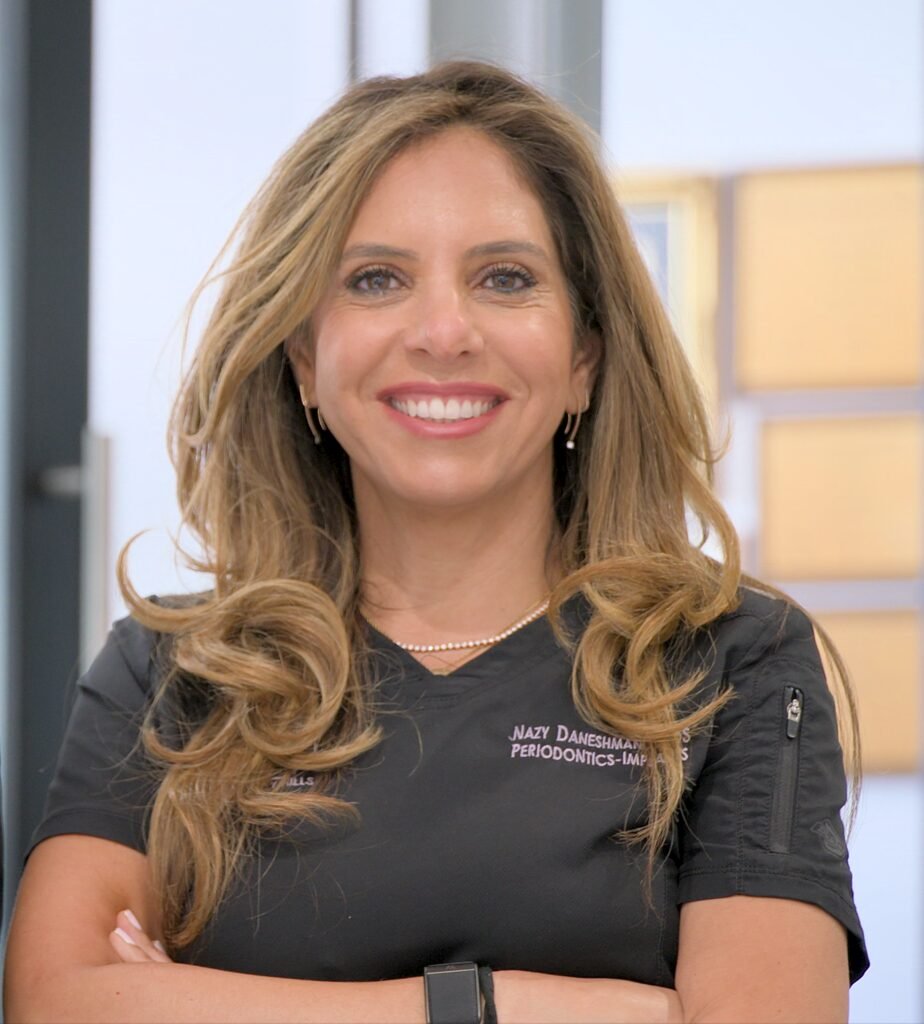
At MD Periodontics in Beverly Hills, we treat women's periodontal health as its own area of care rather than an afterthought. Dr. Nazanin Daneshmand leads this work, and she looks at where you are in your hormonal life before she looks at your gums.
Gum tissue carries receptors for estrogen and progesterone. When those hormone levels rise or fall, blood flow to the gums changes and the immune response in the mouth shifts with it. The same amount of plaque can therefore produce far more inflammation at one stage of life than another.
The effect runs in both directions. Gum disease raises inflammation throughout the body, and that matters more during pregnancy and after menopause than at any other time.
Every woman moves through the same hormonal stages, and each one affects the mouth differently. Below is what we watch for at each point, along with where to read more.
Rising hormone levels make gums swell and bleed, often for the first time. Braces make it harder to clean well, so the two problems compound each other. Most cases settle with good care, though some become the first sign of a longer pattern.
Dedicated page coming soonSome women notice sore or puffy gums in the days before their period. Hormonal contraception can produce a similar low grade inflammation that never quite resolves. Neither is dangerous on its own, but both make existing gum disease progress faster.
Dedicated page coming soonPregnancy gingivitis affects a large share of expectant mothers. Gums bleed, swell, and occasionally form a soft growth that looks alarming and is usually harmless. Because untreated gum disease has been linked to pregnancy complications, this is the stage where treatment matters most and where dental care is often avoided out of caution.
Pregnancy gingivitis and periodontal careAs estrogen begins to fluctuate, the bacteria in your mouth shift with it. Many women in their forties tell us their gums changed and no one could explain why. Testing the oral microbiome gives us an answer rather than a guess.
Oral microbiome for perimenopauseLower estrogen brings dry mouth, altered taste, and in some women a persistent burning sensation. Dry mouth is not a minor complaint. Saliva protects teeth and gums constantly, so losing it accelerates almost every other problem.
Dedicated page coming soonThe jawbone loses density along with the hip and spine. That affects how firmly teeth are held and whether implants are possible. In addition, some osteoporosis medications change how the jaw heals after surgery, which we need to know about before we treat you.
Osteoporosis and bone loss managementEach of these pages goes deeper into one part of women's periodontal care.
When gum inflammation is driven by hormones, standard cleanings often fall short. We adjust both the treatment and the maintenance schedule to match what your body is doing.
Read moreBacterial DNA testing shows exactly which organisms are present, so treatment targets what is actually there instead of what is usually assumed.
Read moreSafe, gentle periodontal care during pregnancy, timed around your trimester and coordinated with your obstetrician when needed.
Read moreProtecting the jawbone as density falls, and planning safely around bone medications before any surgery or implant.
Read moreWomen are told for years that bleeding gums are normal at certain stages. They are common, which is not the same thing.
Dr. Daneshmand is a board-certified periodontist and a diplomate of the American Board of Periodontology, trained at the University of Southern California. Her practice centers on holistic periodontal care and the connection between oral health and whole-body wellness.
She built this area of the practice because she kept meeting women whose gum problems tracked their hormones precisely, and who had never had anyone connect the two. Consequently, every consultation here begins with your health history and your life stage, not just a probe and a chart.
It is common, and it is still worth treating. Bleeding means inflammation, and inflammation during pregnancy has been linked to complications. Gentle periodontal care is safe while you are pregnant, so there is no reason to wait it out.
Yes. The second trimester is usually the most comfortable window for treatment, although urgent problems can be handled at any point. We coordinate with your obstetrician whenever your care calls for it.
Perimenopause shifts estrogen levels for years before periods stop, and the bacteria in your mouth respond to that shift. Testing the oral microbiome tells us what changed instead of leaving you guessing.
Not directly. However, falling estrogen reduces bone density, lowers saliva, and increases gum inflammation. Together those raise the risk considerably, which is why monitoring matters more after menopause than before it.
Hormonal contraception can produce mild ongoing gum inflammation in some women. It is rarely serious by itself, though it can make existing gum disease progress faster. Tell us what you are taking so we can account for it.
Often yes, but this genuinely changes our planning. Certain bone medications affect how the jaw heals after surgery, so we need your full medication history and sometimes a conversation with your physician before we proceed.
Dry mouth is one of the most common and least discussed effects of menopause. Since saliva protects your teeth and gums continuously, losing it speeds up decay and irritation. It is treatable, so please raise it with us.
Bring her in. Puberty commonly causes swollen, tender gums, and most cases resolve with better cleaning. Occasionally it is the first sign of something that needs real treatment, and catching that early is far easier than catching it at thirty.
Your general dentist handles routine care well. A periodontist has three additional years of training focused specifically on gums and bone, which is what you want when inflammation keeps returning or bone loss has already started.
Yes. Both of our doctors are board-certified periodontists, and you are seen by a specialist at every visit. You will never be handed to a general dentist or an associate you have not met.
If your gums have changed and no one has been able to tell you why, that is worth a conversation. Bring your health history, and we will work from there.
MD Periodontics, 9735 Wilshire Blvd, Suite 419, Beverly Hills, CA 90212. Serving Beverly Hills, West Hollywood, Century City, Bel Air, Westwood, Culver City, and Santa Monica.